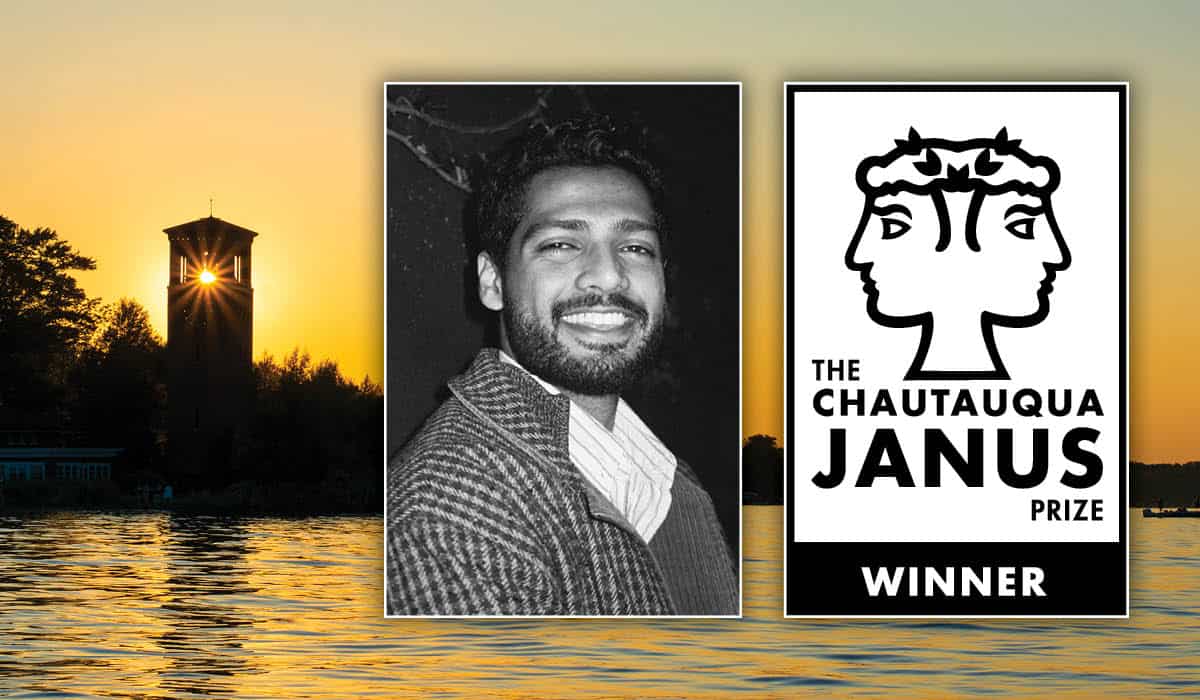
Hassaan Mirza Named Winner of 2026 Chautauqua Janus Prize for ‘Name, Place, Animal, Thing’
Emerging Writer to Give Lecture, Reading of Winning Work on Aug.12
In another record-breaking year for submissions, Chautauqua Institution is delighted to announce “Name, Place, Animal, Thing” by Hassaan Mirza as the winner of the 2026 Chautauqua Janus Prize.
“Name, Place, Animal, Thing” was selected from 10 finalists as the winner by this year’s guest judge Deborah Miranda, who described the short story as “an elegiac, exquisitely crafted piece of fiction that encompasses both personal and global grief, as well as the way such grief taxes sanity and a sense of identity.”
As the 2026 prize recipient, Mirza will receive $5,000, plus travel and lodging for a weeklong writing residency at Chautauqua Institution this summer. He will give a public lecture and reading at a celebratory event at 4 p.m. EDT Wednesday, Aug. 12, in the parlor of the Athenaeum Hotel as part of Chautauqua Institution’s 2026 Summer Assembly.
Hassaan Mirza is a writer from Lahore, Pakistan, currently studying and working as part of the Creative Writing Doctoral Program at the University of Cincinnati. “Dissatisfied with writing realist stories about the immigrant experience,” Mirza stated, “I have felt increasingly drawn to rendering the estrangement of being a foreigner by making stories that might estrange the readers rather than offer them explanations. In my work, I want to complicate the line between humor and grief, and identity and personal narrative.”
Reflecting on Mirza’s piece, Miranda shared that “the title (referring to a children’s game) conveys an innocence from which Anna, the narrator, slowly emerges in the face of a crueler reality.” Every moment of the work holds significance. Even Mirza’s dedication, “For Martha (1885-1914)—the last Passenger Pigeon who was born in captivity and died in the Cincinnati Zoo,” Miranda stated, “is a subtle gesture that resonates with and amplifies many layers of this piece. That’s because in vignettes of memory and musing, Anna, a white woman long married to a man from Pakistan, narrates her experience of distances, loneliness and loss, and how they create webs of captivity.” Using a “gifted ear for dialog that creates and expands characters,” Mirza develops a voice in Anna that “is beautifully true throughout, veering from curious to defensive, angry to sad, nostalgic to practical, sanity to a kind of madness.” Miranda declared that Anna is a “fascinating character, struggling to examine the distance between cultures, countries, between home and work, between husband and wife, between mother and child, between past and present, between the world ‘before’ and ‘after’ COVID-19.”
Miranda praised Mirza, claiming she is “in awe of the author’s ability to depict such delicate, connected strands of history and human despair in a single story.”
Likewise, Chautauqua’s Interim Michael I. Rudell Director of Literary Arts, Stephine Hunt called Mirza’s short story a “beautifully refined and braided narrative about a woman, her family, and a group of bonobos in a zoo that examines the intricacies of choices and mistakes, words and silences, gestures and immobility that define a life, our freedoms and our humanity within a world rife with abundant joy, fear, benevolence and dissonance.”
In “Name, Place, Animal, Thing,” guest judge Miranda concluded, “Mirza shows us our own frightening world, but not without compassion, humor and irony. I see this story as a central piece in a fabulous collection.”
Mirza said that “winning the Janus Prize for this story is, on a fundamental level, an encouragement to continue down the path I am on, and to continue to take more risks in my writing.” He is “thrilled to be able to partake in a residency at Chautauqua Institution and to meet new readers, writers and thinkers.”
“Name, Place, Animal, Thing” was one of 281 entries for this year’s Janus Prize, which has seen a record-breaking number of submissions each year it has been awarded. For Mirza, who noted that “even though writing is a solitary task,” the Janus Prize reminded him that “it can connect me to new communities,” which, he said, “feels nothing short of a gift.”
Mirza’s short story was chosen from a collection of 10 finalists — works that, according to Miranda, were “startlingly unique, ingenious, edgy,” and included a “diversity of genres — sci-fi, poetic essay, speculative, stream of consciousness, testimony, quasi-folktale, polyvocal.” She was struck by “the superb quality of craft within each entry.”
“Collectively,” she said, “they feed my belief that story is the most powerful force in our world, that how we craft experience and imagination into the container of story gives us a way to communicate with one another that is essential nourishment for our humanity.”
Mirza holds an MFA from Vanderbilt University. A former Stegner Fellow in Fiction at Stanford University, he currently works as a visiting research scholar at the University of Cincinnati, where he is also a doctoral candidate in the Creative Writing Ph.D. Program. His work can be found in Ploughshares, Michigan Quarterly Review, Salamander Magazine, Kismet, Joyland and elsewhere. He has finished his story collection that features “Name, Place, Animal, Thing” and is at work on a novel.
Miranda, who will be a Chautauqua Writers’ Center Resident Faculty writer this summer, is an award-winning writer, scholar and enrolled member of the Ohlone-Costanoan Esselen Nation in California. Her hybrid project, Bad Indians: A Tribal Memoir, won the PEN Oakland Josephine Miles Literary Award; the 10th anniversary edition of Bad Indians was released in 2023 as a hardback with 50+ additional pages of material. Miranda is also the author of four poetry collections (Indian Cartography, The Zen of La Llorona, Raised by Humans, and Altar for Broken Things) and co-editor of the Lambda finalist Sovereign Erotics: An Anthology of Two-Spirit Literature. Her scholarship focuses on California Indian experiences within and after Missionization and California Indian storyteller and culture bearers such as Isabel Meadows. She is Thomas H. Broadus, Jr. Professor of English emerita at Washington and Lee University, where she taught Native American Literatures and Creative Writing, and was an affiliate of the Shepherd Poverty Studies Program and the Women and Gender Studies Programs. She and spouse Margo Solod now live in Eugene, Oregon.
ABOUT THE CHAUTAUQUA JANUS PRIZE
Awarded annually since 2018, the Chautauqua Janus Prize celebrates an emerging writer’s single work of short fiction or nonfiction for daring formal and aesthetic innovations that upset and reorder literary conventions, historical narratives and readers’ imaginations. In addition to receiving a $5,000 award and a travel stipend, the winner gives a lecture on the grounds during the summer season. Named for Janus, the Roman god who looks to both the past and the future, the prize honors writing with a command of craft that renovates our understandings of both. The prize is funded by a generous donation from Barbara, Hilary, and Twig Branch. More information can be found at janus.chq.org.
ABOUT CHAUTAUQUA LITERARY ARTS
With a history steeped in the literary arts, Chautauqua Institution is the home of the Chautauqua Literary and Scientific Circle, founded in 1878, which honors at least nine outstanding books of fiction, nonfiction, essays and poetry with community discussions and author presentations every summer. Further literary arts programs at Chautauqua include the summer-long workshops, craft lectures and readings from some of the very best author-educators in North America at the Chautauqua Writers’ Center.
ABOUT CHAUTAUQUA INSTITUTION
Chautauqua Institution is a community on the shores of Chautauqua Lake in southwestern New York state that comes alive each summer — and year-round through the CHQ Assembly online platforms — with a unique mix of fine and performing arts, lectures, interfaith worship and programs, and recreational activities. As a community, we celebrate, encourage and study the arts and treat them as integral to all learning, and we convene the critical conversations of the day to advance understanding through civil dialogue.
###