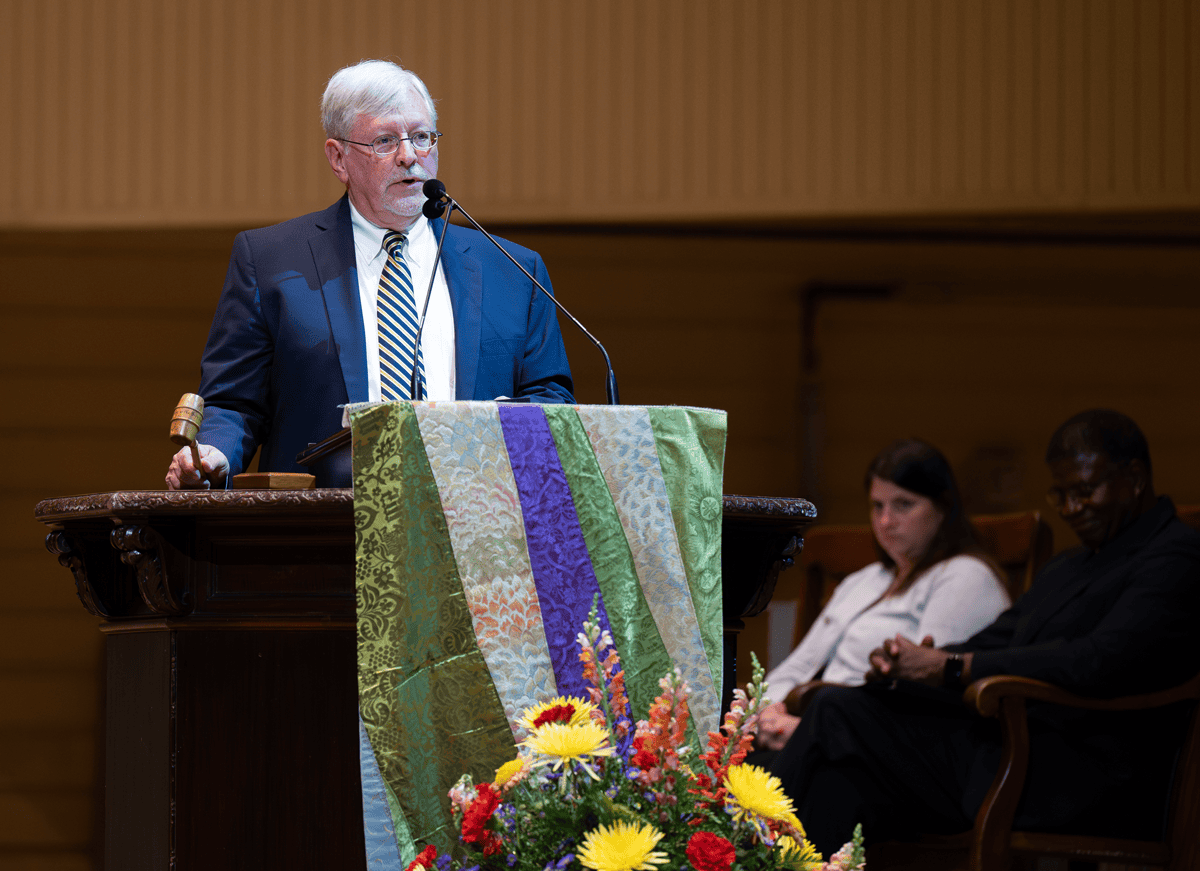
Three Taps of the Gavel closing the 152nd Assembly
Did You Notice?
George T. Snyder, Trustee for Life
Good evening. Where did the time go?
It seems like just yesterday when we opened the season with a riveting discussion between James Carville and Kristen Soltis. Wasn’t it just a few hours ago that we popped our paper bags to simulate cannon fire during the CSO’s performance of the 1812 overture? It seems like minutes — not weeks — since we cheered each other on at the Old First Night Run. The summer here defies space and time. I can’t believe we are closing the 152nd Summer Assembly. But here we are.
It is, once again, my honor and privilege to stand before you — this time in a bookend moment to my opening Three Taps address. In a year marked by leadership transition, it has been a true privilege to help carry forward the tradition of Three Taps.
In my season opening remarks, I asked that you not let anything go unnoticed. Well, did you see it all? Did you notice?
Of course, at Chautauqua, if you so much as blink, you might miss something memorable. Whether you were here for the full season, a few weeks, or just a fleeting visit, we hope you didn’t miss the moments that matter most — the sparks of discovery, the quiet renewal, the laughter of family and friends, and the kind of transformation that only this place can inspire. What a remarkable season it has been.
In my opening Three Taps of the Gavel Address, I also asked you to try something different from what you ordinarily do while here. I quickly learned that I should have been more specific. One of my friends greeted me at the end of Week One and excitedly told me that she had taken my advice and had done something new. I reacted with a big smile, “Oh, that’s great! What did you do?” I asked. She said she had drinks at the Viking Club across the Lake. I was hoping for a more Chautauqua Institution-based experience, but as our Interim Chief Executive Kyle Keogh likes to say, we are a community of communities. All of what we do when gathered here in community matters; and it’s all the stuff of a life well lived.
One of the highlights of Week Two was the collaboration with Lewis Black and the National Comedy Center. Lewis teased us by saying “You people think too much!” At least I think he was teasing. I am reminded that not everyone loves Chautauqua.
Both historian David McCullough in his memorable address from August 9, 1993 “Chautauqua and its Place in American Culture” and Theodore Morrison in his book Chautauqua published in 1974 refer to Rudyard Kipling’s distaste for Chautauqua. McCullough noted that Kipling wrote of being “’Chautauquaed’ to despair.” He called this ‘a lawn tennis tabernacle of the arts and sciences,’ and both McCullough and Morrison included this quote from Kipling: “I don’t like Chautauqua. There’s something wrong with it, and I haven’t time to find out where. But it is wrong.”
Of course, we can’t debate the point with Kipling himself — but had he looked more deeply, and especially across generations of Chautauqua experiences, I like to think he would have discovered that the very things he found to be wrong are, in fact, what make Chautauqua so profoundly right.
Chautauqua has always been somewhat counter-cultural. Our “uniquties” are central to who we are, what we do and, perhaps most importantly, why we do it.
Let me offer just a few examples:
We seek to explore topics from multiple perspectives and to engage in dialogue at a time when most people would prefer to reinforce their own point of view in silence — or in the company of like-minded people. In a divided world, Chautauqua reminds us that dialogue, curiosity, civility, and community aren’t just ideals — they are the very building blocks of a thriving democracy. That’s why Chautauqua exists.
Rather than retiring to our homes each night after dinner, we gather again in community for artistic inspiration through symphonic and popular music, theater, opera, ballet, a weekly Sacred Song Service and more. At Chautauqua, we have the opportunity to not only revisit our passions but discover new ones. We know the arts often speak where words fall short — offering some of the most powerful ways to create meaning and share it with others. That’s also why Chautauqua exists.
We are a community deeply committed to environmental stewardship. Thanks to the dedicated efforts of our Bird, Tree, and Garden Club, Chautauqua Institution has earned Level II Accreditation from ArbNet, recognizing 250 acres of our grounds as a certified arboretum. Their year-round education and advocacy efforts not only enhance the natural beauty of our surroundings but also play a vital role in our collective efforts to reduce environmental impact and preserve this cherished landscape for generations to come.
What Kipling clearly didn’t have time to see was a community that gives back in so many important ways. I wonder what he might say if he knew that a volunteer-led event — our own Chautauqua version of Dancing with the Stars — raised more than $200,000 in a single night to support student scholarships. And, of course, the Chautauqua Dance Circle and the Bird, Tree and Garden Club are just two of more than 40 volunteer and service organizations that bring Chautauqua to life each summer. Please join me in offering our community organizations, denominational houses and religious organizations a sincere thank you. Your presence is also a manifestation of Chautauqua’s mission.
The Chautauqua Kipling observed as “too tame” would later inspire wild generosity, such as that of Chautauquans Craig and Cathrine Greene whose leadership giving is enabling us to renovate a residence hall for future world-class performing artists. The next thing you know, Chautauqua is going to raise more than $20 million to launch the first phase of a much-needed rehabilitation of the historic Athenaeum Hotel. That will be on top of the $156 million it raised in the soon-to-be concluded Boundless Campaign. These are just a few examples among many gifts to Chautauqua. While we may appear tame to some, our passion for this place is exciting — and contagious! Chautauqua’s record of philanthropic support is an incredible testimony to the relevance of our mission.
As we look back on the 2025 Season, there is so much that was right.
Did you see what Chautauqua Opera Company and Chautauqua Literary Arts were able to accomplish when they combined the literary arts with opera to create a one-of-a-kind experience in collaboration with the Metropolitan Opera? Lincoln in the Bardo will one day grace the stage of the Met, and you had the chance to see it here first.
Did you miss the chance to hear Doris Kearns Goodwin, James Carville, Morgan Freeman, Christopher Jackson, Thomas Friedman, Reverend Dr. J. Peter Holmes, Rabbi Peter Berg, or Russell Moore? Did you see the powerful performance of Mahler by the CSO, MSFO and the Buffalo Philharmonic Chorus? Did you steal a few quiet moments by the lake or in your favorite garden? Did you see the world premiere of the new play The Witnesses? Did you check out the new cart paths at the Chautauqua Golf Club?
This place — the fact that it has stood the test of time for more than 150 years; the truth that it inspires us all to be our better selves. It’s not rational. It’s certainly not reasonable. And, isn’t that exactly the point?
Our founders were visionaries. They imagined something that had never existed and willed it into being — not just for their time, but for all time. And each generation of Chautauquans since has been entrusted with the care and evolution of this unreasonable, irrational ideal: A place where all generations of citizens are invited to explore across disciplines, to more deeply examine topics critical to our democratic way of life, and to engage the mind, body and spirit in this journey to more fully realize our collective potential to make the world better.
What’s wrong with all of this is that there isn’t enough of it. Nine weeks, once a year, just isn’t enough, is it?
For staff and for the Board of Trustees, after a brief respite, Chautauqua continues, but in a different way than it does during the summer. We are, of course, searching for the next leader of the Institution. And, you may have heard throughout the Summer, much work must be done to realign the Institution’s annual operating revenues and expenses. Inevitably, difficult decisions will be made — some changes are necessary. Throughout its remarkable history, the Institution has endured during challenging periods: Two World Wars, a receivership, two pandemics (1918 and 2020), the Great Depression and various market corrections. Through all this, the Institution has endured. As an organization that operates primarily in one quarter of every year, Chautauqua is at once fragile and remarkably resilient. With your support and engagement, we will emerge from this period of adjustment with a stronger, even more resilient organization.
As the Board and staff work to address the current challenges, please know that they do so with an undying and unwavering love of this place, this idea. That’s also a Chautauqua tradition and our mission depends on it.
Alfreda Irwin published her book Three Taps of the Gavel: Pledge to the Future in 1987. In it, she devotes a Chapter to “Continuity Through Change.” In her introduction to the Chapter, Alfreda observes:
Change and continuity are two forces which have an astounding kinship at Chautauqua. Sometimes they appear to be at odds, but periodically it becomes apparent that change and continuity at Chautauqua are identical. (p. 73)
Mrs. Irwin then looks at continuity through the lens of the changes in Presidencies. And, here we are again, thinking of change in the context of a search for the next leader of the Institution.
Some issues here recur. Theordore Morrison describes the early portion of Dr. Oscar Remick’s presidency, in the early 1970s:
His new administration confronts both practical and intangible problems. On the practical side, the problems run from the small and particular to those of much more formidable scope. Some Chautauquans complain of the state of the swimming beach, and would like to see it enlarged and improved….Chautauqua suffers from an acute housing shortage…if they are to provide reasonable living space and conveniences for families or for teaching staff. It is perpetually immersed in the struggle for adequate endowment for its programs and for foundation or other grants for special purposes. But its intangible problems are no less important. One of these questions is the question of identity: what is Chautauqua? If it is unique, as it has been called and as Chautauquans proudly assume, in what does its uniqueness consist? (pp. 238-239)
Sound familiar? We have improved on many things, but it is uncanny the number of common challenges and opportunities.
Yet, we would not be here today if we were doing things the exact same way as we did in 1874 or even 1974. As we celebrated Chautauqua’s 150th birthday, we sought to look to the future, while honoring its past. I believe our Founders would expect nothing less from us now.
There is something truly extraordinary that happens on these grounds during the Summer Assembly — something that defies easy explanation. We often joke about how hard it is to describe Chautauqua to those who haven’t experienced it firsthand (although I may try the “lawn tennis tabernacle” description). And in that very uniqueness lies its charm… and perhaps its challenge. This place we hold so dear may not be everyone’s cup of tea — and that’s perfectly fine.
But for those who do find themselves here, even briefly, the magic is unmistakable. Whether you spent the whole season or just a few days, I hope you experienced at least one of those unforgettable Chautauqua moments — the kind that stays with you, quietly shaping your thoughts and spirit long after you’ve left.
May you carry those memories with you throughout the year. And may you continue to notice the gifts that come with being a Chautauquan — not just in summer, but in every season of life.
I tap the gavel three times. Chautauqua 2025 now concludes.