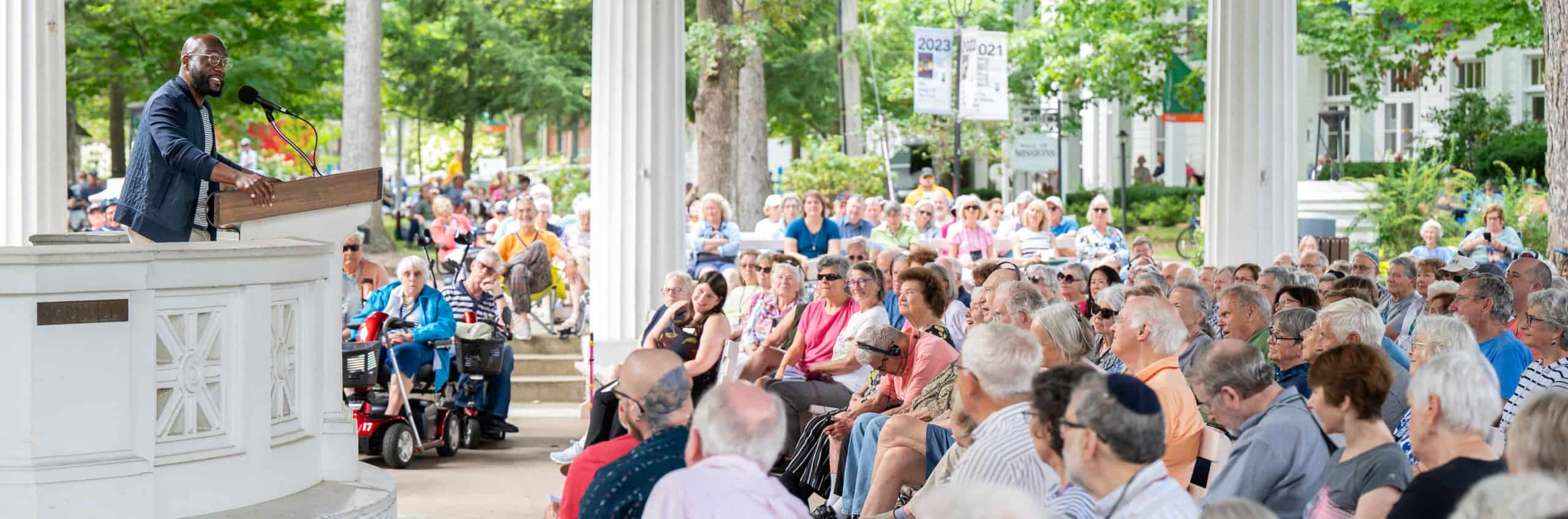
Interfaith Lectures
2 p.m. EDT Monday–Thursday, Hall of Philosophy
The Interfaith Lecture Series is designed to present issues that impact the lived experience of everyday life from theological, religious, spiritual, ethical, and humanitarian perspectives.
Week One • June 27–July 4, 2026
Women of Spirit
Across religious traditions, women have shaped spiritual imagination, moral courage and communal resilience — often without recognition. This week explores the sacred leadership of women who have transformed their faith communities and the world. How do religious traditions empower or constrain women’s leadership? And how might interfaith communities better support a rising generation whose ethics and imagination are reshaping our shared future?
Week Two • July 4–11, 2026
Truth, Trust and the Sacred
In an age of misinformation, fractured narratives and contested truth, religious communities face profound questions: What does it mean to bear witness to truth? How do traditions cultivate discernment, trust and moral clarity? This week examines how moral and spiritual frameworks can help rebuild trust in public life, strengthen media literacy and foster communities capable of deep listening. We explore the ethics of speech, the power of storytelling and the responsibility of faith leaders in a rapidly evolving media landscape.
Week Three • July 11–18, 2026
Faith in the Public Square
As the nation approaches another pivotal election, this week invites an interfaith exploration of how religious and ethical traditions shape civic life. What does it mean to vote, advocate and disagree with integrity? How do communities sustain courage and compassion amid polarization? Drawing on diverse traditions, we consider how practices such as lament, hope, justice-seeking and peacemaking can guide us through political uncertainty and toward more meaningful civic dialogue.
Week Four • July 18–25, 2026
The Ethics of Enough
Many faith traditions teach stewardship, restraint and reverence for creation — values often at odds with a culture of disposability. This week explores how religious wisdom can help us rethink consumption, repair, waste and our relationship to the material world. What practices cultivate gratitude and sufficiency? How do communities confront environmental injustice? And how might faithful collaboration inspire a shift from disposability to durability?
Week Five • July 25–August 1, 2026
The Creative Spirit: Art, Resilience and the Soulful Work of Making
Art has long served as a vessel for spiritual expression, resistance and healing. This week celebrates artists whose work emerges from struggle, faith and resilience. How do religious narratives inspire creative courage? How do marginalized artists draw on spiritual resources to persist? And what does it mean to understand creativity as a sacred calling?
Week Six • August 1–8, 2026
A More Perfect Union: Faith, Memory and the American Promise
As the United States marks its semiquincentennial, this week examines the religious and ethical dimensions of the American experiment. How have religious communities shaped — and been shaped by — the nation’s ideals and contradictions? What does it mean to pursue liberty, justice and flourishing for all? Through reflection and multireligious dialogue, we explore how memory, repentance, celebration and civic faith can guide us in telling a more complete national story.
Week Seven • August 8–15, 2026
Religion, Power and the Moral Stakes of a Changing Global Order
As global power shifts and international norms evolve, religious communities play complex roles in diplomacy, conflict, humanitarian response and cultural identity. This week examines how faith traditions shape global ethics. What responsibilities do nations and religious actors share in promoting peace? How do spiritual worldviews influence responses to migration, climate change and human rights? And how can interfaith cooperation strengthen a fragile international order?
Week Eight • August 15–22, 2026
Feeding the Soul
Food is more than sustenance — it is ritual, memory, identity and community. This week explores the spiritual dimensions of food in a time of ecological strain and technological innovation. How do religious traditions shape our understanding of nourishment, hospitality and justice? What wisdom can faith communities offer as we rethink agriculture, food systems and our relationship to the world around us? And how might growing gardens and sharing meals become paths to healing, belonging and connection?
Week Nine • August 22–30, 2026
The Importance of Gathering: Cultivating the Beloved Community
Leaders from multiple faith traditions explore how intentional gathering — in sacred spaces and beyond — strengthens bonds of compassion and justice. What practices nurture belonging and mutual care across difference? How can these traditions help heal division, foster civic engagement and build resilience in times of uncertainty? As we reflect on the nation’s semiquincentennial, we consider the Beloved Community as both a spiritual aspiration and a practical framework for a more inclusive future.